Vibes DIY
Explore Philosophy

What does it mean
to know something?

Seven interactive thought experiments drawn from the Stanford Encyclopedia of Philosophy — tacit knowledge, the knowing body, situated epistemology, and the AI consciousness boundary.

Start Exploring Join Discord
Beyond Propositions

Ryle's regress shows that skills can't be fully reduced to rules — applying any rule requires knowing how to apply it, all the way down.

The Knowing Body

Cognition isn't housed in the brain and borrowed by the body — it's constituted by the body's engagement with the world.

Who Knows What

The knower's position isn't bias to subtract — it's epistemically constitutive. Objectivity requires locating yourself, not erasing yourself.

How it works

Each app is a thought experiment, not a lecture.

  1. 1
    Pick a topic — choose one of the seven philosophical threads below.
  2. 2
    Engage the argument — the app walks you through the key positions and challenges your assumptions.
  3. 3
    Work through it — write, respond, try to defeat the argument. Your reasoning is saved so you can return to it.
  4. 4
    Build your own view — every app ends with the AI implication: how does this bear on what AI can and can't know?

Seven apps. Seven arguments.

Each draws directly from a Stanford Encyclopedia of Philosophy entry.
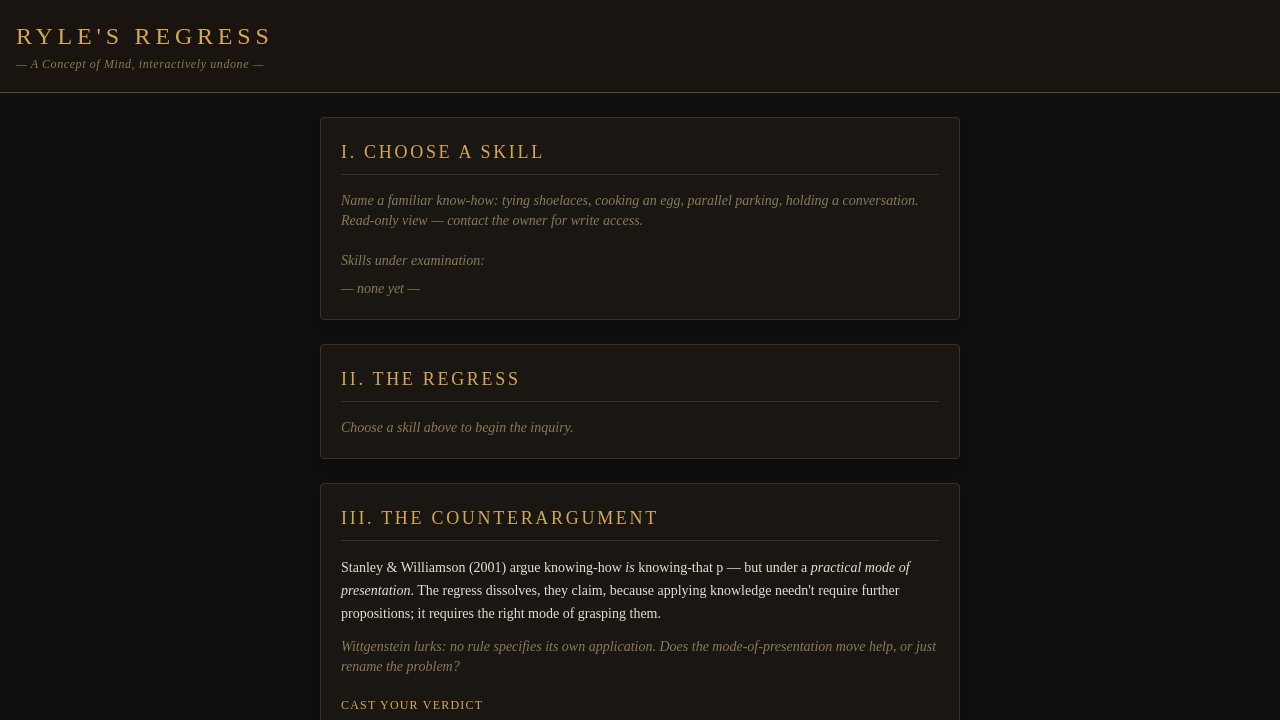
Knowing How vs. Knowing That

Try to reduce a skill to a list of propositions — Ryle's regress argument shows why it always fails.

Embodied Cognition Explorer

Four thought experiments where you can't separate cognition from the body — the cane, the dancer, the native speaker, the phantom limb.

Phenomenology: First-Person

A guided phenomenological exercise — Husserl's intentionality, Heidegger's tool-being, Merleau-Ponty's body schema.

Situated Knowledges
Situated Knowledges

Haraway's view from nowhere, Harding's standpoint epistemology, Fricker's epistemic injustice — the knower's position as epistemically constitutive.

Virtue Epistemology
Virtue Epistemology

Four vignettes — evaluate the reasoner's intellectual character, not just their conclusion. Sosa's reliabilism vs. Zagzebski's responsibilism.

The AI Consciousness Boundary

Chalmers' hard problem, Nagel's bat, Searle's Chinese Room, philosophical zombies — why language production isn't proof of interiority.

The Extended Mind
The Extended Mind

Clark & Chalmers: Otto's notebook is part of his memory. Four escalating cases — does AI extend your mind or shrink it?

Build your own philosophy app

Every app here started as a single prompt. Pick any argument that interests you and build your own version — in minutes.

Start on Vibes DIY